AI can augment speculative behaviour and foster panic, more instability, especially when financial markets are not adequately regulated. AI can…


AI can augment speculative behaviour and foster panic, more instability, especially when financial markets are not adequately regulated. AI can…

The big crisis that erupted in 2008 showed glaringly that very large borrowing and poor regulations can put economies into…
In another text, I argued that AI does not alter economic logic/rationality, nor does it eliminate competition, income and wealth disparities among individuals and groups of people, or between societies/states (“Can AI change economic logic?” Hotnews and Contributors, January 28, current year). What public policies aim to do is to mitigate such disparities and derived social tensions within economies. Internationally, interventions are carried out by specialized international financial bodies such as the IMF, while in the EU, various stabilization mechanisms and structural and cohesion funds operate.
A related question is whether AI can prevent financial or economic crises. The almost automatic answer is no. Because AI does not change economic logic or rationality, and competition does not disappear. In other words, business/economic cycles do not vanish, whether we consider short and medium-term fluctuations in economic activity or longer-term ones generated by investment cycles and major technological breakthroughs that induce technological cycles.

Debates on artificial intelligence (AI) have intensified greatly in recent years. The British government organized a high-level conference on this topic recently. Top officials from the EU and the USA consider AI among their priority policy orientations. Prominent Silicon Valley voices, major companies, are actively engaged in this debate. In Asia, AI is at the forefront of attention. At last year’s annual meeting of the Academia Europaea, Professor Helga Nowotny’s inaugural address and other lectures focused on AI. While the benefits of AI are widely acknowledged, deep concerns about its potentially harmful effects and the possibility of it spiraling out of control are also raised. Can AI be regulated without stifling innovation? Could AI address imbalances between needs and resources sustainably by bringing about abundance for all? This debate is particularly relevant given the significant disruptions of recent years, that have perturbed people’s lives and have led to a “cost of living” crisis with political ramifications.

After almost two years of battling price pressures by embarking on one of the most aggressive hiking cycle in economic history, central banks seem fully committed to go even further with their tightening campaign to rein in runaway inflation should the case be.
This is a battle that central banks can’t afford to lose. Price stability is the ethos of monetary policy and central banks shall remain resolute in their purpose to return inflation to target and preserve their hard earned credibility. But the devil is in the details and even though the destination is well know, there are many unchartered paths and possible journeys, whose choice will reverberates in the years to come.

Public debt sustainability is a concern in many countries. In the US, as the economic linchpin of the developed world, public debt has exceeded 130% of GDP and is causing heated debate, in Congress as well. In the EU, the financial crisis, the pandemic, and the energy transition (with effects augmented by the war in Ukraine) have caused public debts to soar; there are countries in the euro area (Greece, Cyprus, Italy, France, Belgium, Spain, Portugal) with public debts that range between 100% and 175% of GDP. By the way, the ECB was forced to intervene through special operations to save the Eurozone during the sovereign debt crisis.
Abstract After World War II, democracies witnessed transformations that were and are much more lenient vis-à-vis the rise in inflation.…
High inflation in many countries will not be defeated by firm monetary policies alone, nor will it be tackled without…
During a short time span, the macroeconomic backdrop and monetary policy challenges shifted dramatically in a way hardly seen in the recent history. Thereby, from a prolonged period of subdued inflation to a period of high inflation and potentially stagflation; from persistent and extended efforts to increase the degree of monetary accommodation to sustained actions of tightening to rein in the runaway inflation
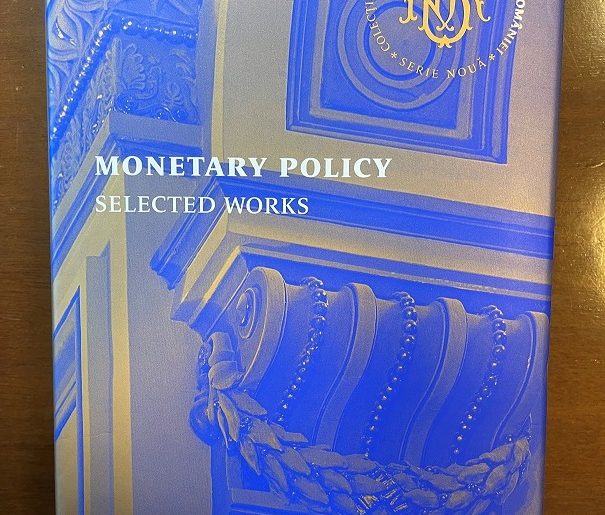
This book is a collection of studies written from 1993 to 2017 by economists who worked or are still working at the National Bank of Romania. Specifically, the book contains nine such studies, of which eight make up the bulk of another book published in Romanian. I had the honour of being asked to write the forewords for both works. For this reason, the foreword to this book is vastly similar to the one worded for the book published in Romanian. The two forewords are different in that this one makes reference to the two papers that this book contains aside from the one in Romanian and, obviously, does not refer to the studies contained in the book published in Romanian but not included in this book, with three exceptions, about which I will warn the reader right before I refer to them. The reason why I will refer to those three studies, although they are not included in this book, is that they treat similar issues and are more recent. I will make the reader aware of the references to these three papers at the right moment.