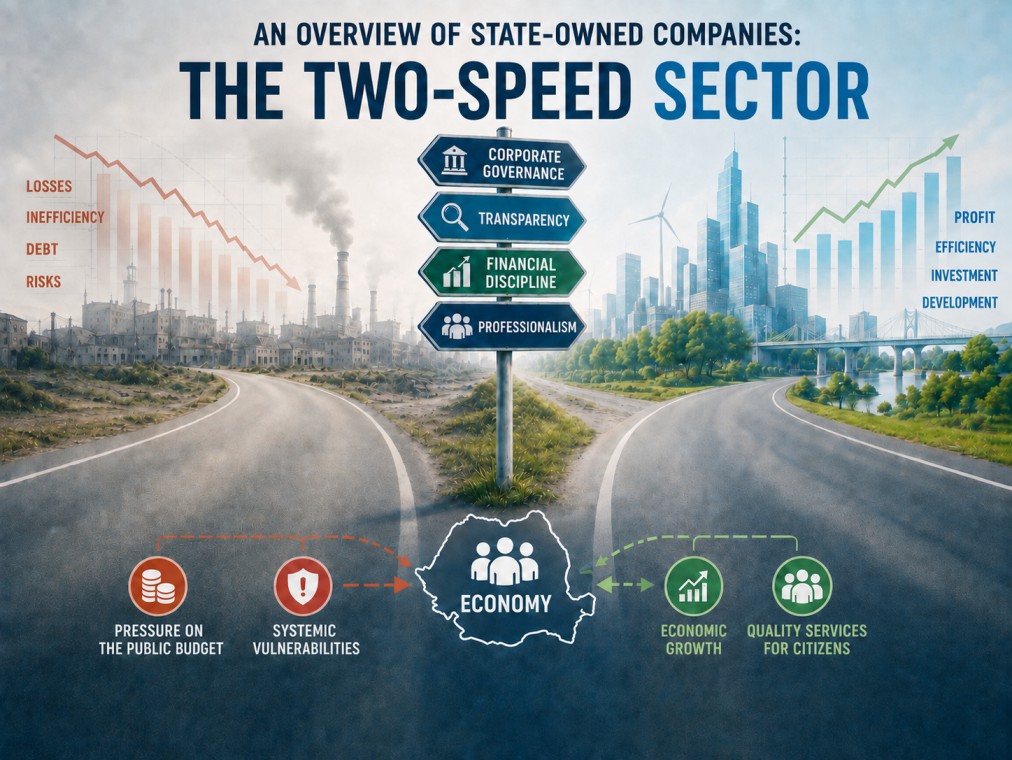
The performance of state-owned enterprises (SOEs) has broad direct implications for the economy through the quality of the services provided, as well as through financial discipline and the manner of implementing corporate governance principles. A poor management of SOEs results in increased costs, inefficiency and vulnerabilities spilling over to the rest of the economy. When managed in a professional and transparent manner, these companies can underpin investment and economic growth, particularly in strategic sectors.
We have analysed the situation of state-owned enterprises in the recently published volume entitled “Financial Sustainability – From Deficits to Nominal Convergence” under the Economic@BNR project. The chapter on state-owned enterprises shows a heterogeneous sector, with substantial differences in profitability, solvency and financial discipline.
The role of SOEs has predictably decreased to half over the past 20 years, this sector’s contribution to the value added in the economy shrinking from 13% in 2004 to 6% in 2024. The structural analysis depicts a sector running at two speeds.
For instance, the top 10 state-owned enterprises operate mostly in the energy sector and their financial performance is well above the average for private companies, due also to the privileged market positions specific to national companies.
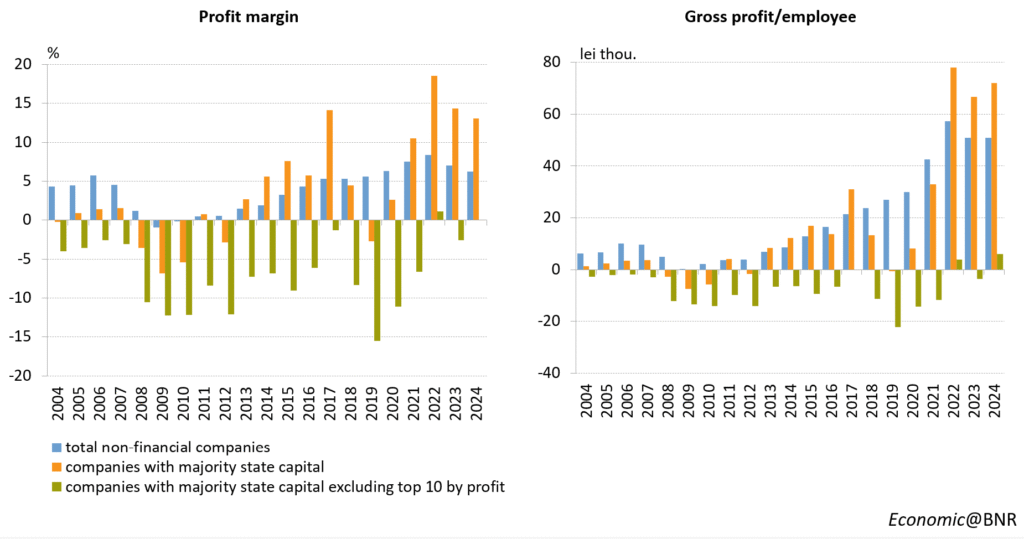
However, in comparison to this small group, the rest of state-owned enterprises are facing significant financial challenges that tend to grow visibly stronger in times of economic downturn. This signals that SOEs in this group have management, operational efficiency and financial discipline problems. Moreover, wage costs have recently gone above 50% of these companies’ turnover, which also points to oversized payrolls. In fact, although state-owned enterprises in Romania use their assets relatively efficiently at aggregate level as compared with their peers in other European countries, the profitability per employee is however subdued.
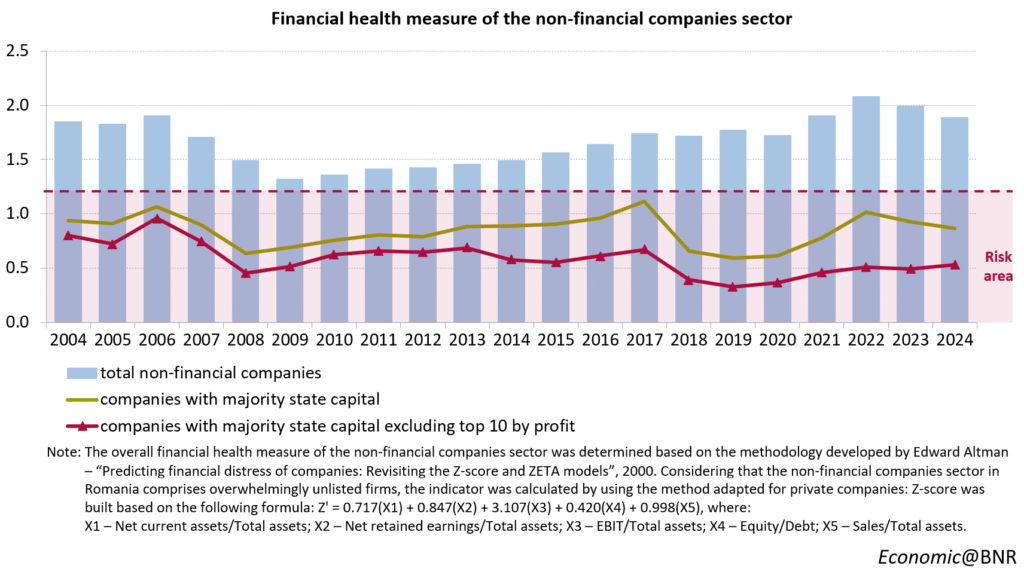
The financial health measure confirms this assessment: SOEs are inside the risk area, being more vulnerable in terms of solvency and liquidity than private companies. The differences are much more pronounced for enterprises with low profitability and have grown stronger over the past 10 years: the level of indebtedness rose by approximately 14 percentage points, while the liquidity ratio went down towards 60%. This is in stark contrast to the developments recorded by private companies: a reduction in the level of indebtedness by 9 percentage points and an increase in the liquidity ratio to over 120%.
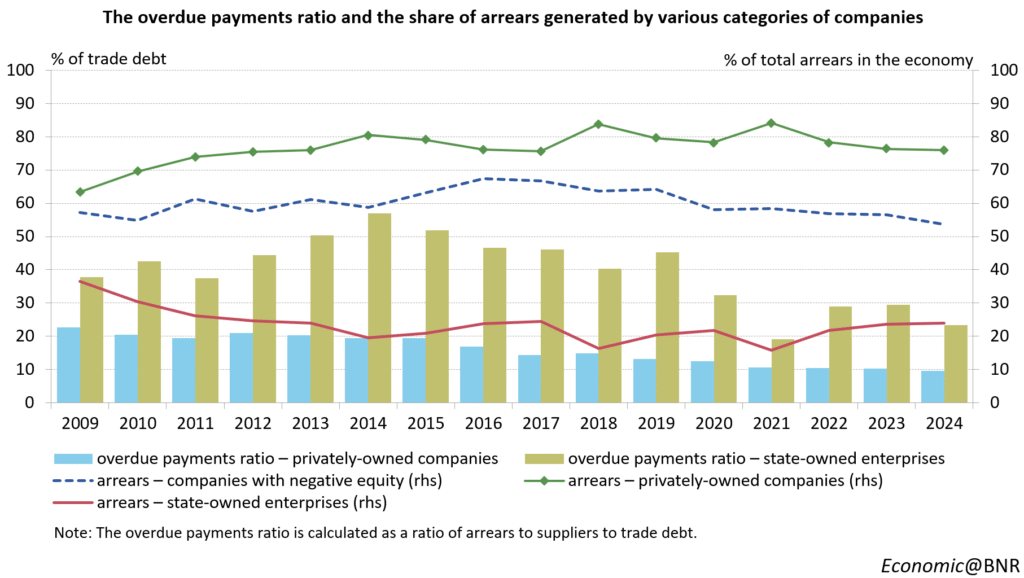
The financial challenges of the SOEs also reflect in their payment behaviour. These companies are late in paying their bills to suppliers, as the payables payment period is generally three times longer than the average payment period in the economy. The overdue payments ratio, albeit significantly improving in the past 10 years, remains however considerably higher, at more than 20% as compared to merely 9% for private companies.
Moreover, in relation to the general government budget, state-owned enterprises further generate a large volume of overdue payments: more than 30% of own overdue payments and approximately 40% of arrears to the general government budget of all non-financial companies are attributed to state-owned enterprises.
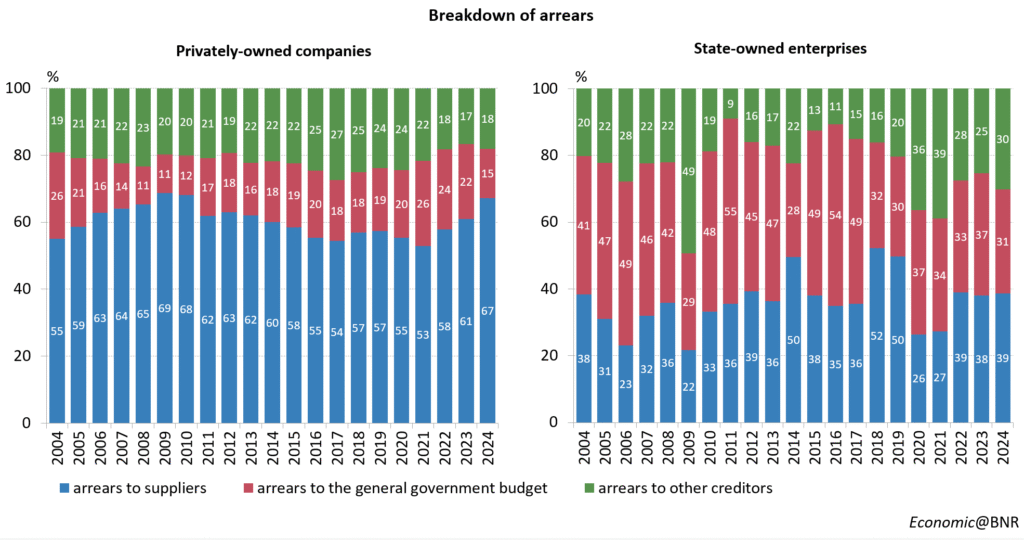
Under the circumstances, concern for SOEs’ corporate governance is fully justified, and alignment with the best practices in the field, such as those recommended by the OECD, must continue at a fast pace. Nevertheless, the results will depend on the consistency, transparency, and rigour with which corporate governance best practices are implemented.
As of 2022, once the preparation process for the accession to the OECD started, Romania has made significant progress in aligning to the organisation’s standards. The OECD’s assessments acknowledge Romania’s advancements in recent years, but still signal certain deficiencies.
One measure to improve the corporate governance framework of state-owned enterprises, which was also intended for the fulfilment of an NRRP milestone, was the establishment of the Agency for Monitoring and Evaluation of Performance of Public Enterprises (AMEPIP), which plays a key role in enhancing the management quality of state-owned enterprises.
An analysis of the management of public enterprises points to the need to quickly reduce the share of temporary positions in favour of permanent positions, earned through a selection process based on transparency and competence. This will lead to an improvement in the corporate governance and management of state-owned enterprises.
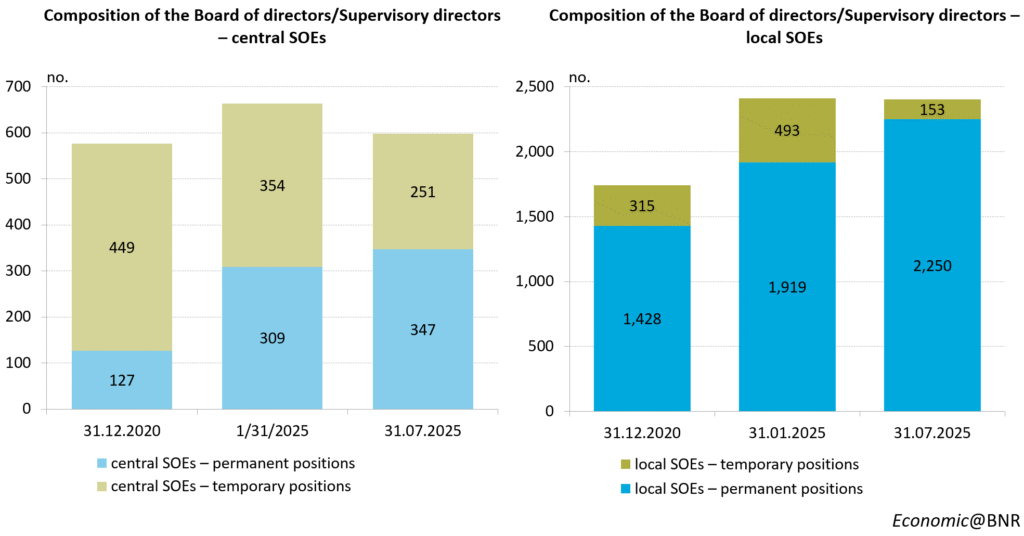
Furthering and stepping up the efforts to professionalise state-owned enterprises’ management and enhance transparency and corporate governance, also by implementing the reforms committed to under the NRRP, to which the selective and strategic listing of part of the shares of SOEs may add, are lines of action that can help strengthen the sector’s financial performance and develop Romania’s capital market.
Therefore, the synthetic overview of state-owned enterprises paints the picture of a sector running at two speeds: on the one hand, there are a small number of well-performing companies that are entitled to claim competitive positions at regional and European level, and, on the other hand, a vast majority of enterprises are facing financial and structural vulnerabilities.
The key priority must be to improve the performance of companies in the latter group and to narrow the gaps with the private sector. Hence, this calls for other management and monitoring tools and mechanisms than those currently in use. It is essential to strengthen financial discipline, to restructure unviable activities, and to more strictly pursue efficiency, innovation and market-based objectives.
When managed according to the principles of governance, transparency, and accountability, state-owned enterprises can become a benchmark for stability and resilience, especially in strategic sectors that must provide, for example, energy security or national defence. However, in the absence of substantial progress, the value of strategic assets of the state-owned enterprises’ sector will erode further, at the cost of economic risks and financial contagion.