
The persistence of external imbalances increases the dependence on foreign capital flows and affects financial sustainability. In Romania, external imbalances have structural causes: demand exceeds domestic output, so we consume more than we produce, and imports outpace exports.
A sustainable narrowing of external imbalances cannot be achieved only through price and productivity gains, but also through base expansion of exporting firms and geographical diversification of markets. In the new global trade landscape, trade diplomacy tools become essential for boosting exports and gaining access to new markets.
The volume Financial Sustainability – From Deficits to Nominal Convergence, recently published as part of the Economic@BNR project, includes a chapter dedicated to external imbalances. The magnitude and persistence of trade and current account deficits entail risks to and pressures on macroeconomic stability and foreign financing.
In an economy with a high import content, such as Romania’s, the strong stimulation of domestic demand can cause external deficits to widen abruptly, as also pointed out by the European Commission’s recent study entitled Romania’s Growth Drivers and Macroeconomic Policy. Specifically, in 2024, amid the strongly expansionary fiscal policy, the twin deficits – the general government deficit and the current account deficit – increased sharply, hence the major risks to financial sustainability.
The consolidation of public finances, which started in 2025, has made, however, the fiscal deficit decline significantly, as shown by the budget execution data for the first half of this year. Nevertheless, turning to external imbalances, the fiscal adjustment was not accompanied, at least for the time being, by a corresponding correction of the current account deficit, which could stay above 7% of GDP in 2026 as well.
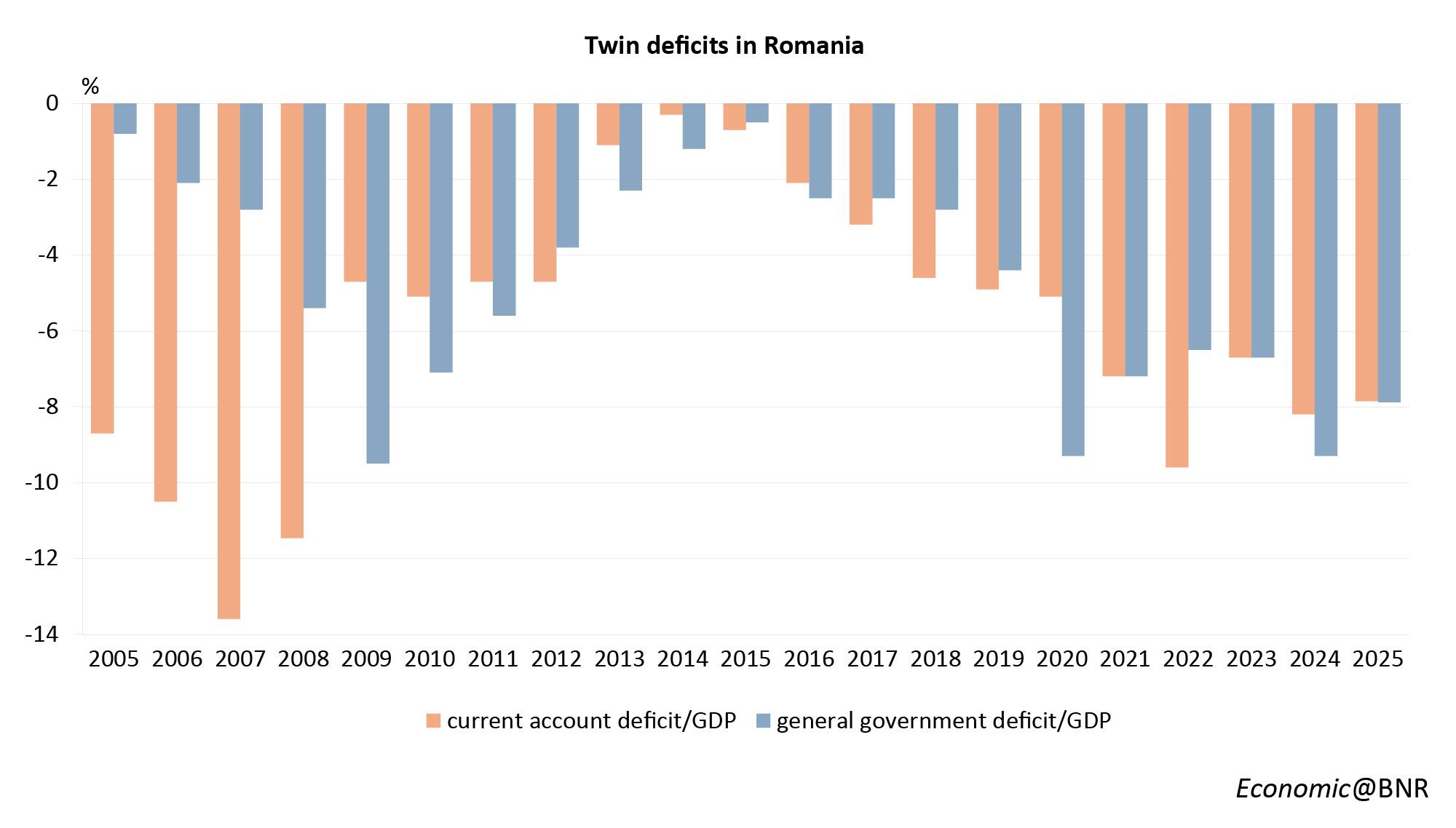
From this perspective, the conclusions of the IMF’s latest External Sector Report are also relevant for Romania: persistent external imbalances cannot be sustainably corrected via a circumstantial squeeze in imports or via trade measures. Economic policies are therefore necessary to support domestic production as well as export competitiveness. Geographical diversification of exports is critical, especially now, when global trade is undergoing a strategic reconfiguration that could increase dependence on imports, of energy in particular.
The agri-food sector is a case in point for export competitiveness. Romania is one of the European Union’s top grain exporters. Between July 2025 and May 2026, grain exports exceeded 10.3 million tonnes, only 2 million tonnes short of France’s and twice as much as those of Germany or Poland. In the cereals group, Romania reported an average trade surplus of 0.8% of GDP over the past five years.
However, this performance masks major structural vulnerabilities. Romania exports primarily agricultural commodities, but imports processed food items, with a much higher value added. The deficit on trade in processed food was approximately 1.8% of GDP, more than double the cereals surplus on average, during the period 2021 – 2025. Hence, exports are important not only in terms of volume, but also in terms of quality, through the position of the economy in the production and value chains.
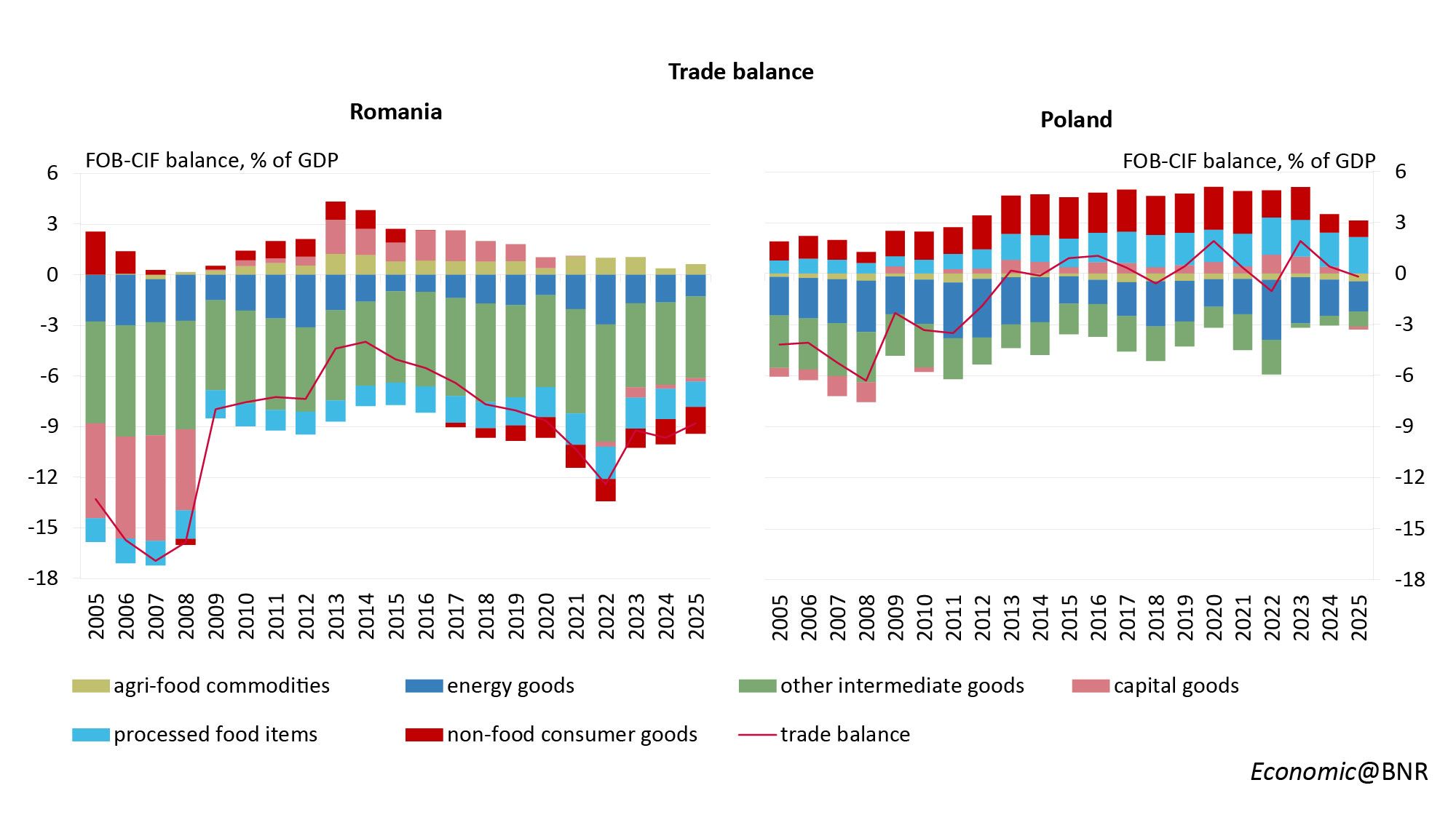
The comparison with Poland speaks for itself. By integrating a greater part of the agri-food chain into the local economy, Poland managed to record large trade surpluses in the food segment. This difference shows that competitive advantages hinge not only on the ability to win a foothold in foreign markets, but also on the capacity to retain within the domestic economy as much of the value chains as possible.
In such contexts, marked by the persistence of external imbalances, the composition of capital flows becomes as relevant as their size. While foreign direct investment flows were prevalent two decades ago, portfolio investment and external loans have gained ground in recent years, bringing along related risks and costs.
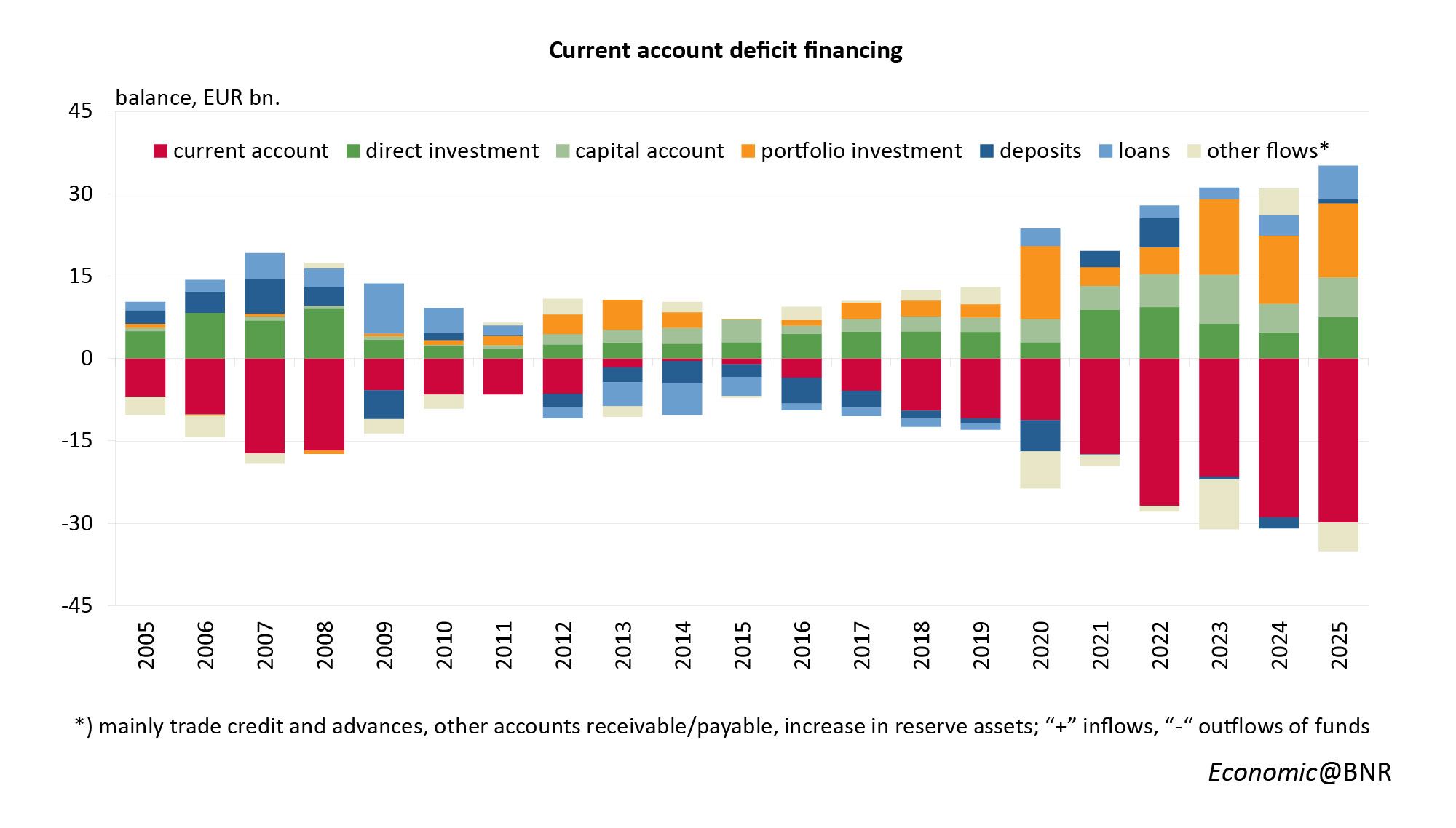
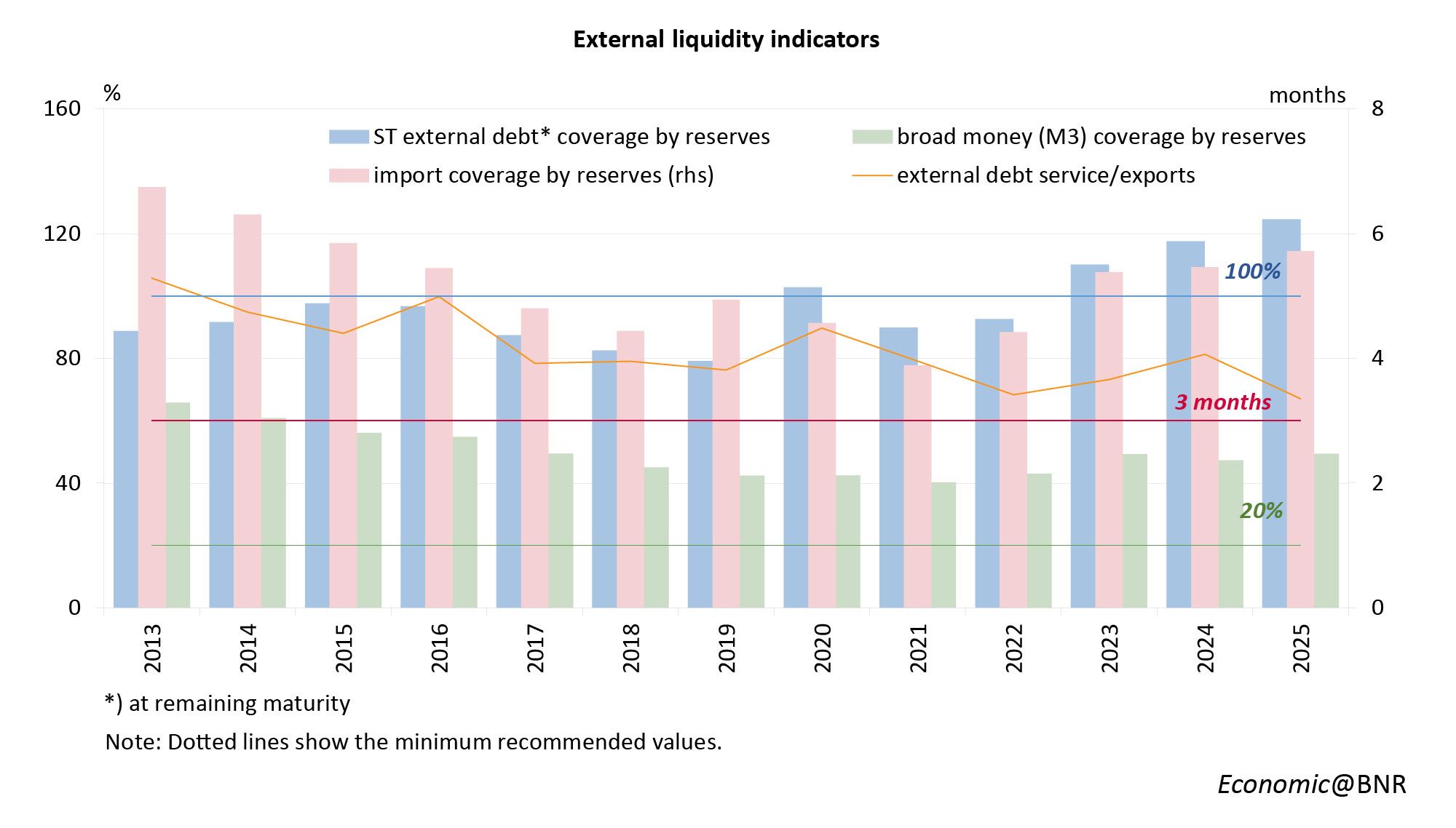
This development is relevant because debt financing can cover short-term deficits, but increases exposure to higher funding costs and shifts in investors’ risk appetite in financial markets. Nonetheless, for Romania, external liquidity remains adequate, underpinned by international reserves and a low debt service relative to exports. However, this safety margin does not make up for the necessary structural adjustment of the macro imbalances the country has been facing in recent years.
Thus, external imbalances reveal the limits of the consumption-based growth model, where domestic demand grows at a faster pace than the economy’s capacity to produce competitive supply, with excess demand being covered by imports.
When domestic demand is mostly met by imports, the consequence is straightforward: Romania’s imports generate output and jobs abroad, and dependence on foreign funds increases, along with the ensuing risks.
Foreign flows based mainly on capital instruments can mitigate the risks associated with external imbalances, but cannot root out their structural causes. The lasting reduction in external vulnerabilities calls for policies focused on supporting national production and a deeper integration in global and European value chains, so that Romania’s exports become increasingly competitive and resilient.
However, export growth is also dependent on firms’ access to attractive foreign markets and on the geographical diversification of export destinations. To this end, foreign trade diplomacy is an important vector of competitiveness.
Post Scriptum: Fitch affirming Romania’s sovereign rating is fully justified by several technical arguments, which are essential for our economic performance in the current period: fiscal deficit reduction by 1.65 percentage points of GDP in 2026 H1 compared to the same year-ago period; estimates of a substantial decline in inflation rate, by approximately 2 percentage points monthly, in both July and August, as a result of base effects; clear prospects of economic recovery in 2027, given the economic growth forecasts of more than 2%, according to the macroeconomic projections of the International Monetary Fund and the European Commission; international reserves of almost EUR 75 billion, which ensure full coverage of short-term external debt at residual maturity; and, last but not least, robustness of the banking sector, where key prudential indicators remain above the EU average.