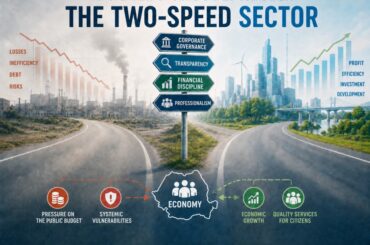

Romania has the lowest level of financial intermediation in the European Union, whereas Romanian firms have among the highest levels of indebtedness. Understanding this paradox is crucial in assessing the financing of companies. Developing Romania’s economy on sound foundations means concrete and effective paths to support financing channels, making higher financial intermediation imperative. Without strengthening this channel, the economy’s potential remains insufficiently harnessed.
We have analysed the situation of financial intermediation in the recently published volume entitled “Financial Sustainability – From Deficits to Nominal Convergence” under the Economic@BNR project, a volume that will be launched soon, via public debates organised by the NBR. Chapter VII on the banking and financial system in Romania highlights the transformation and development of our financial infrastructure over the past two decades, as well as its role in the economy, from a regional and a European perspective.
Financial intermediation is the financial system’s capacity to mobilise savings and funnel them into consumption and investments. This process is essential for an economy’s long-term development, with banks serving as the traditional financial actors enabling the allocation of financial resources within the economy.
The development of the financial system is an essential, but not sufficient condition for economic expansion. A sustainable increase in financial intermediation means that the financing supply must be closely matched to the needs of the economy and demand must be eligible: well-capitalised firms, viable projects, corporate governance, and financial discipline. In this respect, financial education contributes substantially to the proper understanding of the benefits, risks, and borrowing costs.
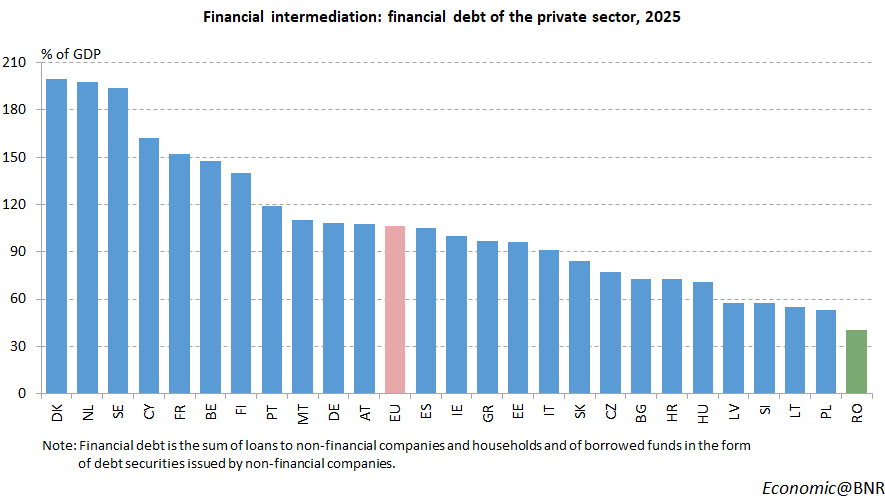
The level of financial intermediation can be assessed based on indicators that capture both the extent of lending to the economy and the size of the banking sector. One of the most used financial intermediation indicators is the share of private sector credit in GDP. The 40% of GDP recorded in Romania is significantly below the EU average of 106%.
As shown in the chart below, Romania posts the lowest level of financial intermediation among EU Member States, at a considerable distance of more than 10 percentage points of GDP from the second-to-last in the ranking (Poland). This gap, however, is not limited to banking system performance: the size of the non-bank financial sector is also among the smallest in the EU.
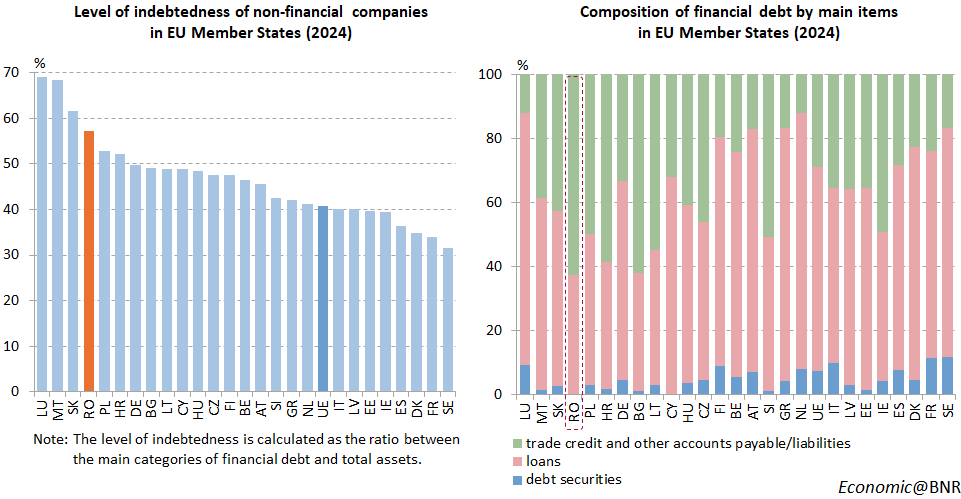
Nevertheless, the low financial intermediation stands in contrast with companies’ high level of indebtedness. This paradox is illustrated by the corporate capital structure. While intercompany loans and trade credit account for a third of companies’ financing sources, loans from domestic banks and NBFIs make up less than a tenth. This lending is equivalent to the volume of cross-border intercompany credit from non-residents.
This situation indicates, on the one hand, companies’ preference for alternative financing sources, including for cost reasons, and, on the other hand, the low degree of bank intermediation. For a third of companies, net assets are less than half of the subscribed share capital, which points to major capital shortfalls.
Most firms do not resort to lending from banks of NBFIs: more than 80% of SMEs and approximately half of large companies did not apply for any loans in the past year, which might have supported investment projects without straining operating activity. Moreover, firms postpone paying outstanding supplier invoices to preserve operational cash flow for alternative financing needs (trade credit). This practice of late payments exposes both the creditor and the debtor to cascading liquidity management and default risks.
Consequently, an accurate understanding of the costs and risks associated with different funding types is essential. For businesses that rely extensively on trade credit, this financing method proves more expensive than a bank loan.
To understand why, the invoiced amount can be viewed as credit extended by a supplier to a corporate client. As an illustrative example common in Romania, let us consider an invoice with a 60-day payment deadline and a 2% discount for settling the balance within 10 days. If a firm chooses to pay at the final deadline rather than early, the annualised cost of giving up that discount is 15.7%, allowing for a direct comparison with other credit options.
This percentage represents the threshold that must be taken into account when, in order to secure a discount, the paying firm decides to tap a bank loan or a credit line. In practice, institutional financing offers a far more favourable interest rate for the paying firm, across all maturities. For instance, over the past three years, the net-of-commission interest rate on new loans to non-financial companies averaged 8.6%, peaking at just 9.3%.
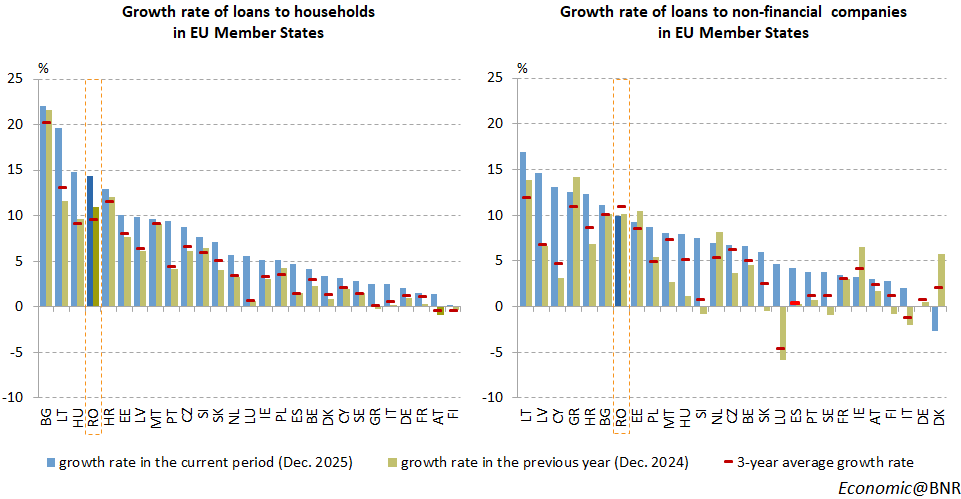
In the post-pandemic period, Romania emerged as one of Europe’s most dynamic credit markets, with household and corporate lending expanding at an average rate of about 10% over the past three years, as set out in the chart above. In recent years, a significant structural realignment has occurred within the corporate credit segment, particularly among SMEs: the share of financing for equipment purchase widened to one third of the corporate portfolio from one fourth in 2023.
The sustained lending growth over the past few years can be attributed, in part, to the stimulative nature of real interest rates on new loans, which shape the consumption and investment behaviours of households and firms alike. Real interest rates acted as a relative incentive on the financing of economic activity, given that, amid high inflation, nominal interest rates remained, however, attractive enough for taking out new consumer and investment loans.
Nevertheless, the significant interest rate differential between Romania and the external environment, especially the euro area, raises competitiveness issues in investment financing for the firms operating in foreign markets.
Structural vulnerabilities of non-financial companies curb their capacity to withstand shocks and compound credit risk assessment, thereby hindering their access to loans. Compared to EU Member States, the share of trade credit, as set out in the chart below, is the highest in Romania, similarly to Bulgaria and Croatia.
Corporate governance issues, the prolonged payment delays between firms, the cost of assessing borrowers, especially those in financial distress, and the weak effectiveness of insolvency proceedings escalate the borrowing costs.
Against this background, only a small share of Romanian companies are granted the full amount of financing requested from banks and non-bank financial institutions. According to the Survey on the access to finance of non-financial corporations in Romania (June 2026), this percentage has been below 20% for SMEs and less than 50% for large companies over the past year.
Banks are inclined to extend fewer loans, even when holding sufficient resources, if they anticipate higher recovery costs for those loans. The literature refers to this as ‘credit rationing’, the most relevant study being that authored by the economists Joseph E. Stiglitz and Andrew Weiss: “Credit Rationing in Markets with Imperfect Information”.
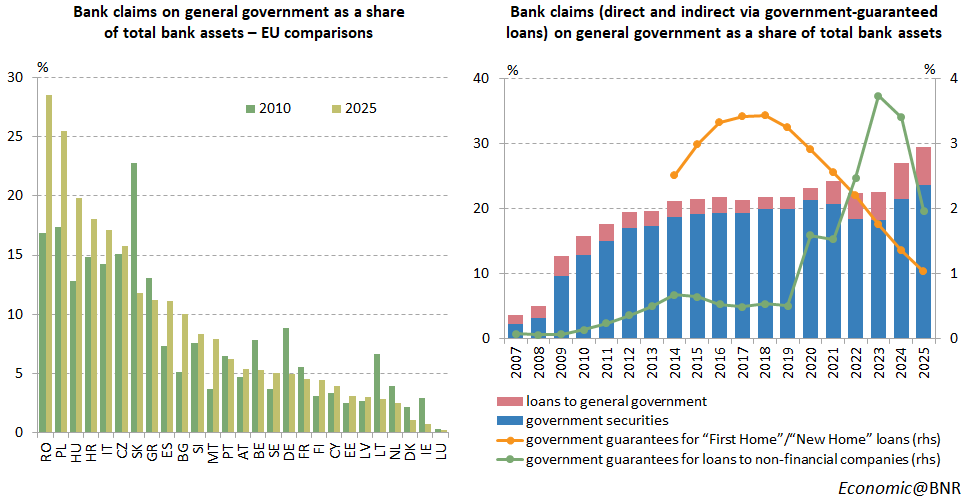
In Romania, especially during these years, the financing of the economy is marked by significant pressure from the crowding out effect, amid much higher borrowing needs of the general government in recent years. And when the government spends and borrows more, interest rates go up and the private sector invests less. The increased financing requirement of the public sector affects both the availability of finance for the private sector and particularly the cost thereof. After all, more money for the state means less money for the economy.
Local banks have steadily expanded their holdings of government securities, which reached approximately lei 230 billion in 2026 Q1, three times more than 10 years ago. Government securities provide banks with more straightforward and rapid ways for liquidity deployment, given the much more favourable risk-reward ratio compared to the alternative of lending to non-financial companies and households. This is also highlighted by the past decade’s developments in the loan-to-deposit ratio, which shrank from 86% at end-2015 to 67% in March 2026.
The figure below depicts the surge in government exposures as a share of bank assets in Romania over the last 15 years, from 17% in 2010 to 28% in 2025, the highest level among EU countries. Next in line come the Polish and the Hungarian banking sectors, with around 25% and 20% respectively of government exposures in total bank assets.
Increasing financial intermediation takes more than a mere advance, through any means, in the volume of lending. In order for the financing of the entrepreneurial sector to deliver lasting benefits for the economy, it must operate within prudential standards to avoid the build-up of new vulnerabilities across companies and the financial sector.
The capital market, which has a huge potential for the Romanian financial system, also plays a particularly important role in enhancing access to finance. In recent years, the Bucharest Stock Exchange posted significant increases, reflecting investors’ positive outlook. However, Romania further records a low stock market capitalisation-to-GDP ratio, of about 30%, well below the euro area level, yet comparable to the countries in the region. The number of listed companies, while on a steady rise, is still low relative to the number of active companies in the economy, and the remarkable achievements have to do rather with the listing of state-owned giants, such as Hidroelectrica, than with a sizeable influx of private companies that are open to public listing.
Against this background, the sustainable development of financial intermediation cannot take place without improving financial discipline and corporate governance or without a predictable macroeconomic environment, capable of underpinning economic confidence and investment.
Yet this essential objective cannot materialise through standalone actions, but only via concerted efforts and developments: companies strengthening their capital and their capacity to generate viable projects, the banking sector supporting the financing of investments within the entrepreneurial sector, and the government acting firmly and consistently in narrowing imbalances, so as to limit the recent pressure on public debt financing.
These are essential prerequisites for ensuring that increased financial intermediation becomes the transmission belt in the mechanism supporting the financing of the economy, through productive investment creating new business opportunities and new jobs. Only thus can we regain, in 2027, the much-needed robust economic growth!